

Nitrogen for Tomatoes: Its Role and How to Get It Right
The best nitrogen fertilizer for tomato plants provides steady, early-season energy for strong vines and lush leaves. However, once flowers appear, you must switch to a low nitrogen fertilizer for tomatoes to prevent massive, fruitless plants. Properly managing nitrogen ensures your tomatoes develop the necessary foliage to support a heavy harvest.
Why tomato plants need Nitrogen (N)
To truly master the art of growing heavy, juicy tomatoes, you need to understand the relationship between nitrogen and tomatoes. Nitrogen is the “N” in the standard NPK ratio found on every bag of commercial plant food (standing for Nitrogen, Phosphorus, and Potassium). Of these three primary macronutrients, nitrogen is the biological engine that drives the physical size and structure of your plant.
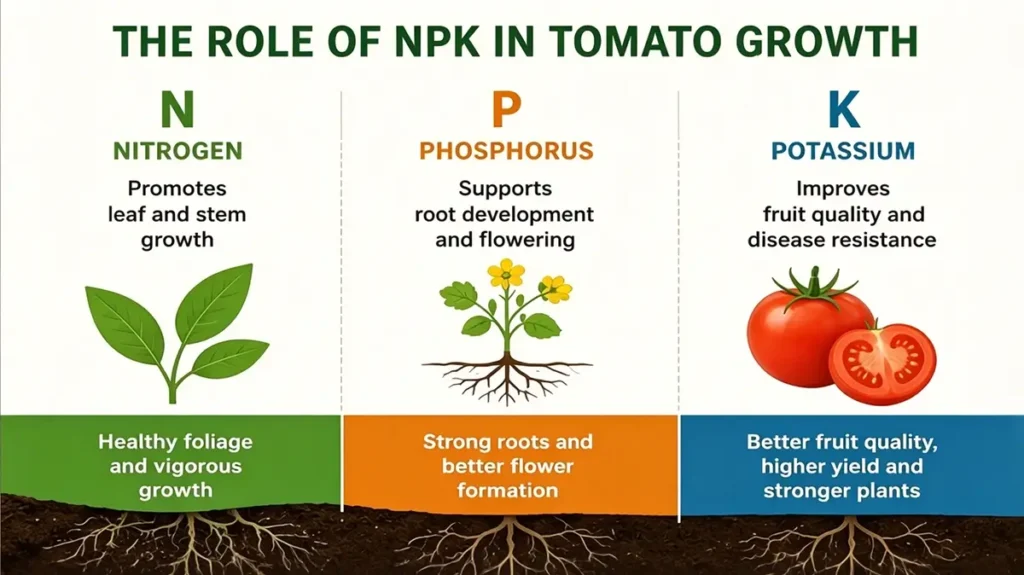
On a cellular level, nitrogen is an essential component of amino acids, which are the building blocks of plant proteins and enzymes. Most importantly for your garden, nitrogen is a critical structural element of chlorophyll. Chlorophyll is the green pigment that allows plants to absorb sunlight and convert it into energy through photosynthesis. Without sufficient nitrogen, your tomato plant simply cannot manufacture the food it needs to survive, let alone produce a heavy crop.
During the early stages of a tomato’s life—from a tiny seedling to a rapidly expanding vine—nitrogen is the most heavily consumed nutrient. Your goal during this early vegetative phase is to help the plant build a thick, sturdy main stem and a massive canopy of large, broad leaves. Think of these leaves as solar panels. The more healthy, green leaves your plant can produce early in the season, the more solar energy it can capture. That energy is later redirected into producing, sizing, and ripening your tomatoes.
Furthermore, a robust leaf canopy provides necessary shade. Without a thick covering of leaves fueled by an adequate nitrogen tomato fertilizer, the developing fruits are highly susceptible to sunscald, which can blister and ruin your harvest before it even ripens.
Signs of deficiency and excess
Because nitrogen plays such a commanding role in the garden, applying the wrong amount will quickly lead to visible distress. Learning to “read” your tomato plants will help you identify whether you need to add more nutrients or flush the soil.
Identifying Nitrogen Deficiency
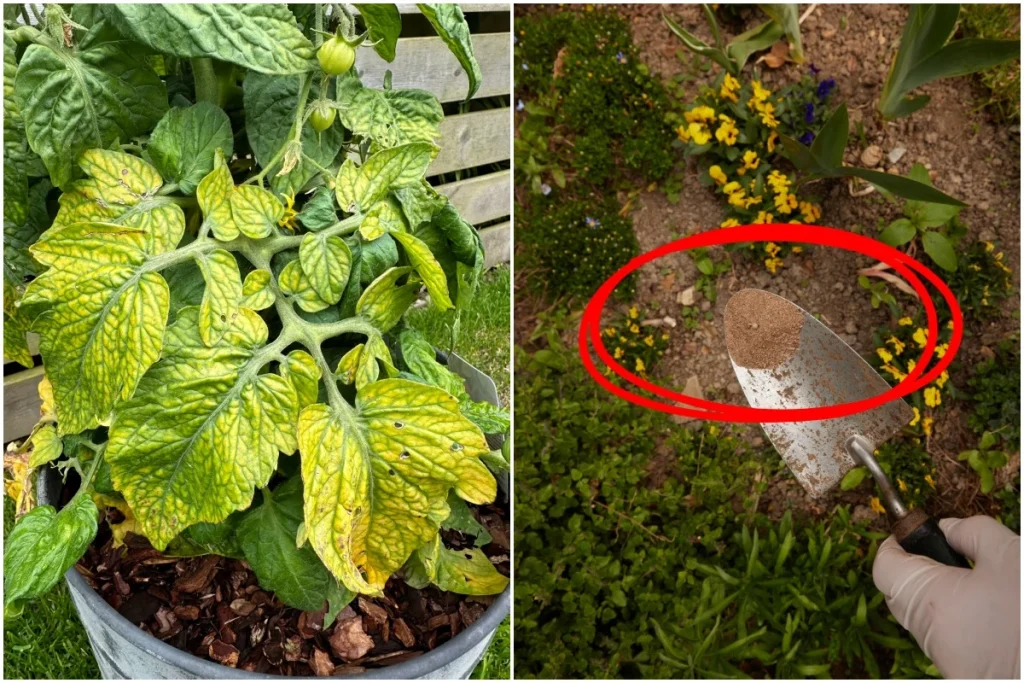
Nitrogen is what horticulturists call a “mobile” nutrient. This means that if the soil runs out of nitrogen, the tomato plant is smart enough to cannibalize itself. It will actively move the remaining nitrogen from its older, lower leaves and send it up to the new growth at the tip of the vine to keep surviving.
Because of this mobility, the very first sign that you need a nitrogen fertilizer for tomato plants is the yellowing of the lowest leaves on the main stem (a condition called chlorosis). While the top of the plant might still look somewhat green, the bottom leaves will turn a pale, sickly yellow and eventually drop off.
Other signs of nitrogen deficiency include:
- Severely stunted overall growth.
- Spindly, thin main stems that easily snap in the wind.
- Smaller-than-average leaves that lack a deep, vibrant green hue.
- Premature flowering on a plant that is far too small to support the weight of actual fruit.
Identifying Nitrogen Excess (Toxicity)
In the home garden, nitrogen excess is actually far more common than nitrogen deficiency. It usually happens when a well-meaning gardener applies a standard lawn fertilizer to their vegetable beds, or continually applies a high-nitrogen feed deep into the summer.
When you apply too much nitrogen for tomatoes, the plant responds by growing with explosive, uncontrollable vigor. You will end up with a massive, incredibly beautiful, dark-green jungle of vines and leaves. However, this comes at a devastating cost: the plant will completely ignore reproduction.
Signs you have over-applied nitrogen include:
- “All vine, no dine”: The plant is huge and bushy, but produces absolutely no blossoms or fruit.
- Blossom drop: The plant may produce flowers, but immediately drops them before fruit can set.
- Delayed ripening: The few tomatoes that do manage to grow will take an agonizingly long time to turn red.
- Pest vulnerability: The rapid, weak cellular growth caused by excess nitrogen creates soft, sappy foliage that is a magnet for aphids and hornworms.
Additionally, dumping excessive nitrogen salts into the soil can disrupt the plant’s ability to absorb other vital nutrients. This rapid growth spurt often outpaces the root system’s ability to uptake calcium. This imbalance directly contributes to calcium deficiency, causing the bottoms of your tomatoes to rot and turn black. How to fix and prevent blossom rot in the garden.
Natural vs. commercial sources
When choosing a nitrogen fertilizer for tomatoes, you will need to decide between organic vs. synthetic options. Both can successfully grow highly productive plants, but they interact with your garden soil in entirely different ways.

Commercial (Synthetic) Nitrogen Sources
Synthetic fertilizers are chemically manufactured to deliver a concentrated, immediate dose of nutrients. Common sources include urea, ammonium nitrate, and calcium nitrate.
- The Pros: They are incredibly fast-acting. If your plant is actively yellowing and starving for nitrogen, a water-soluble synthetic feed will green it up in a matter of days. Furthermore, products like calcium nitrate provide a double-benefit by delivering immediate nitrogen alongside highly soluble calcium.
- The Cons: Synthetics are essentially concentrated mineral salts. If you apply too much, it is very easy to cause “fertilizer burn,” which desiccates the roots and kills the plant. They also do nothing to build long-term soil health or support the beneficial microbes in your garden bed.
Natural (Organic) Nitrogen Sources
Organic nitrogen for tomato plants comes from natural plant, animal, or mineral byproducts. Because nature rarely produces a perfectly balanced NPK ratio, you often use specific ingredients to target nitrogen.
- Blood Meal: One of the most potent organic nitrogen sources available, boasting an NPK of roughly 12-0-0. It is fast-acting for an organic input and is excellent for a pre-planting soil boost.
- Fish Emulsion: A liquid fertilizer made from processed fish waste (usually around 5-1-1). It is fantastic for seedlings and early vegetative growth, though it does have a strong odor.
- Alfalfa Meal and Feather Meal: Slower-release organic options that feed the soil microbes, which then slowly break down the nitrogen into a form the plant roots can absorb.
- Composted Coffee Grounds: A gentle, free, slow-release nitrogen source (roughly 2% nitrogen) that also improves soil texture.
- The Pros: Organic sources are “slow-release,” meaning it is very difficult to accidentally burn your plants. They also improve the overall structure, drainage, and biological health of your soil year after year.
- The Cons: Because they rely on soil microbes to break them down, they work very slowly in cold, early-spring soils.
Whether you choose organic or synthetic, the most important factor is knowing when to stop. As soon as your plant transitions from growing leaves to setting fruit, you must switch to a low nitrogen fertilizer for tomatoes (such as a 3-4-6 or a 5-10-10 blend) to ensure the plant directs its energy toward the harvest.
Recommended dosage by growth stage
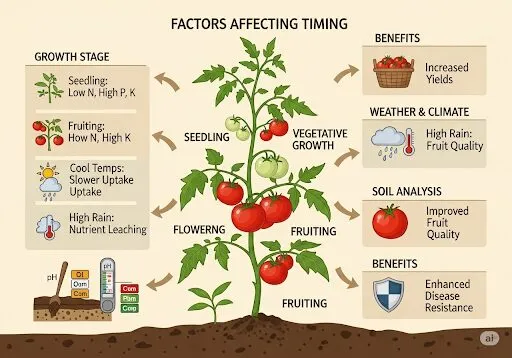
To maximize your yield, your feeding strategy must adapt as the plant matures. A static feeding schedule is a recipe for poor harvests. Use the following table as a guide to adjust your nitrogen application throughout the growing season.
| Growth Stage | Nitrogen Need | Recommended NPK Focus | Feeding Strategy & Dosage Guidelines |
|---|---|---|---|
| Seedling (Indoors) | Low to Moderate | Balanced (e.g., 5-5-5) | Dilute a liquid fertilizer to 1/4 strength. Apply once every 10-14 days after the first true leaves appear. Prevents spindly, weak stems. |
| Transplanting | Moderate | High Phosphorus (e.g., 5-10-5) | Mix a slow-release granular fertilizer into the planting hole. The moderate nitrogen supports early leaf growth without burning delicate new roots. |
| Early Vegetative | High | Balanced (e.g., 10-10-10) | Apply a standard dose of liquid or granular feed 2-3 weeks after transplanting. This builds the foundational leaf canopy needed for the rest of the year. |
| Flowering & Fruit Set | Low | High Potassium (e.g., 3-4-6 or 5-10-10) | CRITICAL SHIFT: Cut nitrogen significantly. Switch to a low nitrogen fertilizer for tomatoes. Excess nitrogen here will cause blossom drop. |
| Peak Harvest | Low | High Potassium (e.g., 5-10-15) | Maintain low nitrogen. Focus purely on potassium and phosphorus to support fruit sizing, flavor development, and ripening. |
FAQ
What’s the ideal amount of Nitrogen (N) for tomato plants?
The ideal amount depends on the growth stage, starting high and tapering off. Early on, a balanced fertilizer works well, but you should switch to a low nitrogen formula (like a 5-10-10) once blossoms appear. This ensures the plant focuses on fruiting rather than just growing more leaves.
What happens if tomatoes get too much Nitrogen (N)?
If you apply too much nitrogen, your plants will grow massive, dark green vines with very few flowers or fruits. This excessive vegetative growth also makes the plant more susceptible to pests and diseases. Furthermore, it can disrupt the uptake of other nutrients, indirectly contributing to issues like blossom end rot.
How can I tell if my tomato plants need more Nitrogen (N)?
The most obvious sign of a nitrogen deficiency is the yellowing of the older, lower leaves while the new growth at the top remains pale green. The plant’s overall growth will also be stunted, and the main stems will appear unusually thin and weak.
Does Nitrogen (N) affect fruit taste or yield?
Yes, nitrogen directly impacts yield by building the foundational leaf canopy needed to fuel fruit production. However, too much nitrogen during the fruiting stage will drastically reduce your yield and can lead to watery, less flavorful tomatoes.
